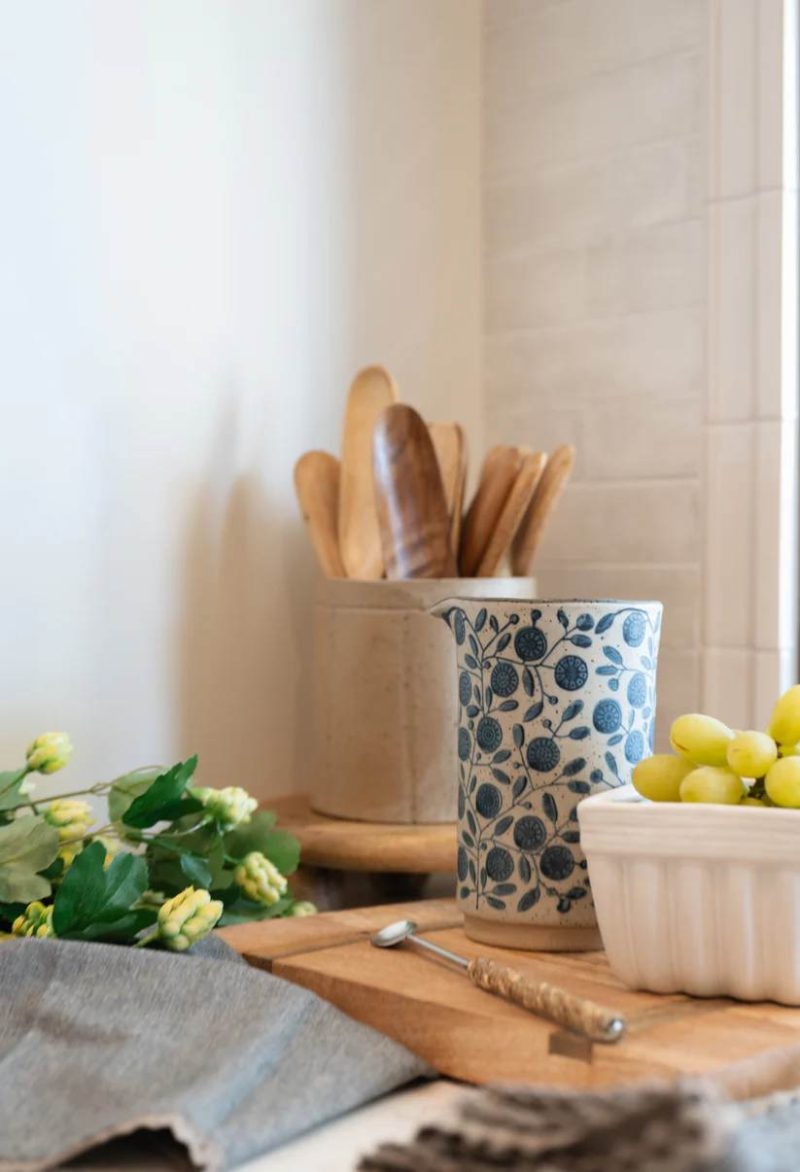
A marble cutting board can serve two roles in a kitchen: a useful surface when appropriate for the task and a decorative element when it is not in use. The challenge is displaying one in a way that adds texture and visual interest without turning valuable counter space into a crowded arrangement.
The most effective approach is usually simple. Give the board a defined location, keep surrounding kitchen accessories limited, and consider how its size, shape, and veining relate to the materials already in the room.
This matters particularly in kitchens where counters need to work hard. Decorative styling can make a kitchen feel more finished, but every item left out also occupies usable space. Marble boards work well in this situation because their natural pattern and substantial appearance allow a single object to contribute visually without requiring a large collection around it.
Why Do Marble Cutting Boards Work as Kitchen Decor?
Marble has natural variation in color and veining, so even a relatively simple board can introduce visual texture.
That can be useful in kitchens dominated by smooth cabinets, plain countertops, stainless appliances, or neutral finishes. A board leaning against a backsplash creates another surface and pattern without introducing a bright color or elaborate ornament.
It can also bridge functional kitchenware and home decor.
Unlike an accessory purchased solely to fill an empty corner, a board may already have a practical reason to be in the kitchen. Keeping an attractive one accessible can therefore make the room feel styled without adding an object that serves no other purpose.
The goal, however, should not be to make every functional item visible. Good counter styling depends on editing. A marble board can become the anchor of an area precisely because fewer objects are competing with it.
Start by Choosing the Right Location
Before adding bowls, jars, utensils, or other accents, decide where the board itself belongs.
Look for a location that does not interfere with everyday preparation.
The section immediately beside a sink may need to remain open for washing and drying. Space near a cooktop may be more useful for frequently reached cooking items. A primary prep area generally benefits from having as little permanent decor as possible.
That often makes the back portion of a counter a better display zone.
A board can lean vertically against a backsplash or wall, using depth rather than taking over the entire work surface. This keeps more of the countertop available while still allowing the marble to remain visible.
In kitchens with open shelving, a suitable board may also be displayed on a shelf when it is not needed regularly.
Lean Rather Than Lay Flat
One of the simplest ways to reduce countertop clutter is to change the orientation of the board.
A board lying flat occupies nearly its entire footprint. The same board positioned upright against a backsplash uses considerably less working depth.
Vertical placement also makes the object’s shape and natural veining more visible.
This technique can be particularly helpful when displaying marble cutting boards alongside other restrained home accents. Rather than building a large countertop arrangement, the board itself can provide the visual backdrop for one or two practical items.
Make sure any vertically displayed board is positioned securely and is not likely to slide or fall. Its size, weight, surface, and surrounding conditions should determine whether leaning storage is appropriate.
Avoid Building a Large Vignette Around the Board
Once a decorative board is in place, there can be a temptation to surround it with several accessories.
A utensil holder appears. Then a candle. Then a vase, bowl, grinder, small plant, bottle, and decorative object.
Individually, each item may look appealing. Together, they can consume the counter and reduce the impact of the board.
Instead, treat the board as one of the primary visual elements.
If it already has strong veining, an interesting outline, or noticeable contrast with the backsplash, it may need very little accompaniment.
One or two nearby objects are often sufficient. A crock containing utensils might provide height. A small bowl may add a lower shape. An item used every day may be preferable to another object included only for appearance.
The more visual character the marble provides, the less additional decoration may be necessary.
Layer Boards Carefully
Layering boards can create depth, but restraint is particularly important when the goal is keeping counters open.
One marble board placed in front of a slightly larger wood board can create useful contrast between cool stone and warmer wood. The different heights and materials make the arrangement visible without requiring several small accessories.
But continuing to add boards can quickly turn styling into storage.
Ask whether each visible board adds something different. If three pieces have nearly identical proportions or finishes, displaying all three may not improve the arrangement.
Two contrasting pieces are often enough to establish a layered look.
Keep the stack relatively shallow so it does not project unnecessarily into the work area.
Use Material Contrast Instead of More Objects
An attractive kitchen arrangement does not depend entirely on quantity. Material contrast can create visual interest with fewer items.
Marble works particularly well beside materials that look noticeably different from it.
Wood introduces warmth and grain. Woven fibers contribute texture. Ceramic pieces can provide softer, rounded forms. Metal creates a harder contrast, while linen introduces movement and a softer finish.
A marble board alongside one wood item and one ceramic container may therefore feel more dimensional than five accessories made from similar materials.
This principle can help homeowners simplify kitchen accessories while still creating a collected look.
Instead of asking, “What else can I add?” ask, “Is there already enough variety in material, height, and shape?”
Often, the answer will reveal that fewer pieces are necessary.
Pay Attention to the Board’s Shape
Shape influences how much visual weight an object carries.
A rectangular board can reinforce the horizontal and vertical lines already present in cabinetry and tile. A board with rounded corners or a less rigid outline can soften those lines.
Consider what the kitchen already contains.
If nearly every feature is rectangular—from cabinets and appliances to backsplash tile and countertops—a board with a curved top can introduce variation without adding another color.
Conversely, a simple rectangular board may work well in a kitchen that already contains many curved vessels or rounded decorative pieces.
Thinking about shape helps the board participate in the larger room rather than functioning as an isolated accessory.
Let the Marble Pattern Provide the Detail
Natural stone does not need much embellishment.
Depending on the stone, marble can contain subtle or pronounced veining, variation in tone, and irregular patterning. That existing detail should be considered before introducing patterned towels, containers, artwork, or other nearby elements.
If the board has dramatic black-and-white contrast, surrounding it with quieter pieces may help keep the countertop balanced.
A softer board with restrained veining may tolerate more texture nearby.
The idea is not to follow a rigid matching formula. It is simply to recognize that the board itself already contributes pattern.
When every item in a small area has a strong pattern, none of them receives much visual breathing room.
Keep the Main Prep Zone Clear
Counter styling works best when it respects how the kitchen is actually used.
Identify the area where most chopping, mixing, assembling, or plating happens. Then protect that zone from permanent decorative arrangements.
There is little value in creating a beautiful countertop display that needs to be relocated every time dinner is prepared.
Move decorative kitchen accessories toward secondary zones instead.
Depending on the layout, that might mean the back corner of a counter, an area beside a refrigerator, a section away from the main cooktop, or a shelf.
This functional zoning can make even a relatively small kitchen feel calmer because the objects left out have defined places rather than spreading across every available surface.
Create Height Without Creating Bulk
One reason boards are useful in counter styling is that they add height while remaining relatively shallow when displayed vertically.
Height draws the eye upward and makes an arrangement more visible.
A marble board against the backsplash may therefore eliminate the need for several stacked accessories designed to accomplish the same thing.
If another item is placed nearby, choose a height that complements rather than duplicates it.
For example, a shorter bowl in front of or beside a taller board creates a clear difference in scale. A utensil crock may also work because the utensils extend upward while serving a practical purpose.
Avoid arranging multiple objects at exactly the same height. Variation generally creates more definition with fewer pieces.
Do Marble Boards Need to Match the Countertop?
No.
Trying to match marble precisely to an existing counter can actually be more difficult than using deliberate contrast.
Natural materials vary, and two different stones that are almost—but not quite—the same can sometimes look more accidental than intentional.
Instead, look for a relationship.
A board might pick up one darker tone found elsewhere in the room. Its warmer veining could connect with wood cabinetry. Black detailing might relate to hardware, lighting, or appliances.
The connection can be subtle.
Home decor usually feels more natural when materials coordinate rather than appear to have been selected from an identical set.
This also gives homeowners more flexibility when their kitchens combine several finishes.
Should a Marble Board Stay on the Counter All the Time?
Only if it earns the space.
A useful question for any countertop item is whether it contributes enough function or visual value to justify remaining visible.
For someone who regularly uses a particular board or serving piece, accessible storage may make sense. Someone with limited counters may prefer to bring it out only when needed.
There is no requirement that a decorative kitchen piece remain displayed permanently.
Seasonal entertaining, changes in cooking habits, or simply wanting a cleaner surface can all be reasons to edit what stays out.
Rotating accessories can also prevent the kitchen from gradually accumulating too many permanent items.
Remember That Marble Requires Appropriate Care
Marble is a calcium-carbonate-based natural stone and can react to acids. Lemon juice, vinegar, and other acidic substances may etch the surface, so the care instructions for the particular piece should always be considered before using it for food preparation.
Abrasive cleaners can also damage some stone surfaces.
For routine natural-stone care, mild, non-acidic products are generally preferred, but manufacturer or retailer instructions for the specific board should take priority.
That distinction matters because a marble piece used mainly for serving or display may have different care considerations than a heavily used everyday work board.
Also consider the intended task before cutting directly on any decorative stone board. Marble is softer than some other common countertop stones and can be scratched by kitchen utensils.
Using an appropriate work surface for repetitive chopping can help preserve the appearance of a decorative marble piece.
Use Accessories That Have a Reason to Be Nearby
If additional objects are included with the board, prioritize items connected to what happens in that part of the kitchen.
Beside a preparation area, that may mean utensils or frequently used ingredients stored appropriately. Near a beverage station, it may mean cups or another useful serving piece. In an entertaining area, a bowl or serving accessory may make sense.
This produces an arrangement that feels connected to everyday routines.
It also helps prevent decorative drift—the gradual addition of unrelated objects simply because there is room for them.
Kitchen styling becomes much easier to maintain when most visible items have a recognizable purpose.
Edit the Counter From Across the Room
Countertop clutter can be surprisingly difficult to judge while standing directly in front of it.
After arranging a marble board and surrounding objects, step away.
View the kitchen from an adjoining room, doorway, or the opposite side of an island.
From that distance, ask whether there are too many separate clusters competing for attention.
Perhaps the board area looks balanced on its own, but another group of objects sits only a few feet away. Individually both arrangements may work; together they may make the counter appear busy.
Removing an item from one zone can create more visual impact than adding another accessory to either one.
This wider perspective is particularly useful in open-concept homes, where kitchens are frequently seen from living and dining spaces.
A Styled Kitchen Still Needs Room to Work
The most successful kitchen styling does not make a counter look full. It makes the objects that remain feel intentional.
A marble board can accomplish a great deal on its own. Its weight, pattern, shape, and natural material give it enough visual presence to function as part of the room’s decor without requiring a complicated arrangement around it.
Keep it vertical when possible, protect the main prep area, layer sparingly, introduce contrast through materials rather than quantity, and give nearby objects a practical reason to remain visible.
For Fresno homeowners and anyone refining a kitchen one detail at a time, the broader lesson is simple: useful surfaces should remain useful. Thoughtful home decor works with everyday life rather than competing with it.
About Shoppe At The Avenue
Shoppe At The Avenue is a Fresno, California home and lifestyle store at 2037 W Bullard Ave #102, with a curated focus on home accents, kitchen and dining pieces, vintage finds, textiles, wall decor, and everyday entertaining. The store was created by Andrea Van Groningen, founder and principal designer of The Avenue’s home-focused businesses; for current product questions, shoppers can call 559-890-9793 or find the Shoppe’s Fresno location on Google Maps.