Bottom line:
- A licensed general contractor coordinates permits, trade scheduling, and inspections rather than performing all labor personally.
- Verification through the state licensing board confirms active status, bonding, and the correct classification before any contract is signed.
- Reliable construction solutions by Prime Builders and similar licensed firms typically follow a structured sequence from pre-construction planning through final closeout.
Hiring a licensed general contractor means working with a party who manages permitting, subcontractor scheduling, and code compliance on behalf of the property owner. The process typically moves through defined phases rather than a single transaction, which is why understanding what happens at each stage helps set realistic expectations before signing a contract.
Homeowners and developers researching reliable construction solutions by Prime Builders often want to know what separates a licensed general contractor from an unlicensed handyman or a single-trade subcontractor. The short answer involves accountability: a licensed contractor assumes legal responsibility for the full scope of work, including code compliance, inspections, and coordination among multiple trades.
Verifying a License Before Signing Anything
Before any contract is signed, confirming license status is a practical first step for any construction project in Arizona.
- The Arizona Registrar of Contractors maintains a public database where license number, classification, and status can be checked at no cost.
- A license search should confirm the business name matches, the status reads active, and the classification covers the type of work planned, whether residential, commercial, or dual-scope.
- Contractors are required to display their license number on contracts, advertisements, and vehicles under Arizona law.
Skipping this step is one of the more common reasons homeowners end up without recourse if a project goes wrong, since recovery funds and legal protections generally apply only to work performed under a valid, active license.
What Happens During Pre-Construction Planning
A licensed general contractor typically begins with a planning phase before any demolition or construction starts. This stage sets the scope, budget, and schedule that later work will be measured against.
- Initial scope review and site assessment to identify structural, utility, or access constraints.
- Budget development based on materials, labor, and project complexity.
- Permit application and plan submission to the relevant local jurisdiction.
- Scheduling sequence for subcontractors, inspections, and material deliveries.
In Phoenix, AZ, permitting timelines and inspection requirements can vary depending on project type and the municipality handling the review, which makes early coordination between the contractor and the permitting office particularly important for staying on schedule.
Managing Trades, Permits, and Inspections
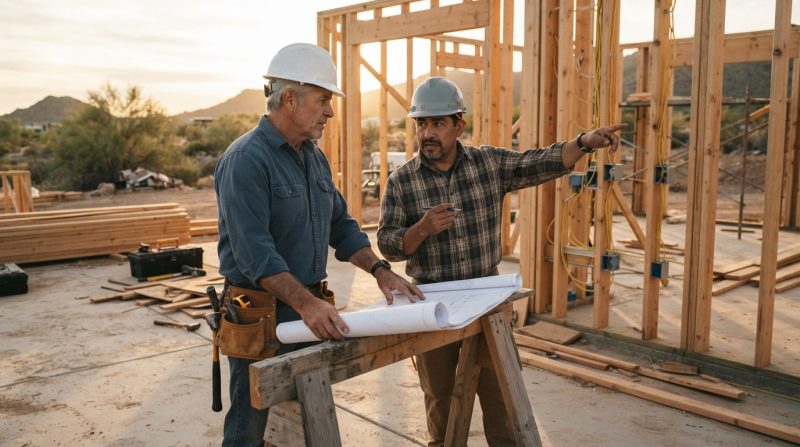
Once construction begins, the general contractor’s core function shifts toward coordination rather than hands-on labor. A general contractor is responsible for supplying materials, labor, and equipment while typically hiring specialized subcontractors for portions of the work, according to a general overview of the role.
This coordination includes:
- Sequencing subcontractors so trades do not conflict with one another on-site.
- Scheduling required inspections at each phase of construction.
- Verifying workmanship against code requirements before advancing to the next stage.
- Managing documentation for change orders, permit amendments, and closeout records.
| Project Phase | Primary Contractor Responsibility | Typical Output |
|---|---|---|
| Pre-construction | Scope, budget, and permit submission | Approved plans and permits |
| Active construction | Trade sequencing and inspections | Completed framing, systems, finishes |
| Closeout | Final walkthrough and documentation | Certificate of occupancy or final sign-off |
Based in the USA, Prime Builders takes on general contracting work across the Phoenix, AZ market, applying this same phased structure to residential, multifamily, and commercial projects.
Business Info
Prime Builders is an Arizona general contractor that manages ground-up construction, renovations, tenant improvements, and related general contracting services for projects in the Phoenix, AZ area, with services detailed through its Google Business Profile.
Frequently Asked Questions
How long does a typical general contracting project take from permit to completion? Timelines depend on project size, complexity, and how quickly local permitting offices process plan reviews, so there is no fixed duration that applies to every job.
What is the difference between a licensed general contractor and a subcontractor? A general contractor holds overall responsibility for the project and coordinates multiple subcontractors, while a subcontractor typically performs one specialized trade under the general contractor’s direction.
Why does license classification matter when hiring a contractor? Classification determines whether a license covers residential, commercial, or dual-scope work, and hiring outside the correct classification can affect legal protections if a dispute arises.
Does a general contractor handle permits directly, or does the property owner need to apply separately? A licensed general contractor typically submits and manages permit applications as part of the contracted scope, coordinating directly with the local permitting authority.
Looking Into Local Contractor Options
Confirming license status, reviewing project history, and comparing how different contractors structure their planning and inspection process are reasonable steps before signing a construction contract. Current service area information for Prime Builders is published for reference alongside other regional contractors.