Short answer:
- A screw conveyor moves bulk solids such as grain, sand, or powders along a trough using a rotating helical screw (auger).
- The design is favored for enclosed, horizontal-to-inclined transport where dust control, metering, or mixing is required.
- Capacity and application depend on screw diameter, pitch, rotation speed, and the trough or tube configuration selected.
A screw conveyor transports bulk material through a tube or trough by rotating a helical blade, pushing product forward in a continuous, controlled flow. This mechanical simplicity is why the design has remained a standard in agricultural, industrial, and processing facilities for well over a century.
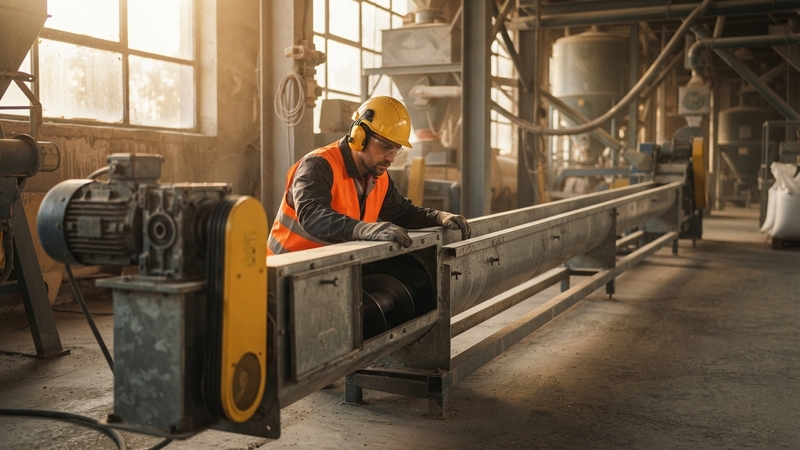
Screw Conveyors consist of a few core components: a rotating helical screw, a trough or tube housing, end bearings, and a drive unit that controls rotational speed. Material entering the trough is caught between the flights of the screw and advanced along the housing as the screw turns, similar in principle to the action of a large-scale auger. Because the housing can be fully enclosed, these systems are commonly selected when dust containment, moisture protection, or material separation from the surrounding environment is a priority.
How the Mechanism Moves Bulk Material
The screw’s geometry determines how material behaves inside the conveyor. Pitch (the distance between flights), diameter, and rotational speed together set the volume of material moved per revolution.
- Standard pitch screws handle free-flowing materials like grain or sand efficiently.
- Short-pitch or variable-pitch designs help control flow of sluggish or compressible materials.
- Ribbon-style screws (without a center tube) are used for sticky or viscous substances that would otherwise clog a solid-core screw.
Trough shape also affects performance. U-shaped troughs suit horizontal runs, while fully tubular housings are typical for inclined or vertical applications where gravity could otherwise pull material backward.
Common Applications Across Industries
Screw conveyors appear in settings where bulk solids or semi-solids need to move short distances with minimal mechanical complexity. Typical uses include:
- Grain handling and storage facilities, moving corn, wheat, or soybeans between bins and processing lines.
- Food and feed processing, where enclosed troughs limit contamination risk.
- Cement, aggregate, and mineral processing, transporting abrasive or dusty materials.
- Wastewater treatment, where screw conveyors handle dewatered sludge or screenings.
The Occupational Safety and Health Administration maintains general industry guidance on machine guarding that applies to enclosed conveying equipment, including screw conveyors, given the rotating components involved. Facilities operating this equipment are expected to follow applicable guarding and lockout procedures regardless of material type or throughput volume.
Screw Conveyor Configurations Compared
Selecting a configuration depends on incline angle, material characteristics, and available space. The table below outlines general distinctions among common types.
| Configuration | Typical Incline | Best Suited For |
| Horizontal trough screw | 0 to 15 degrees | Free-flowing grain, sand, aggregate |
| Inclined tubular screw | 15 to 45 degrees | Space-limited vertical lifts |
| Shaftless screw | 0 to 30 degrees | Sticky, fibrous, or sludge materials |
| Vertical screw | Near 90 degrees | Short-distance vertical elevation |
These distinctions matter because selecting the wrong configuration for a given material or incline can lead to reduced throughput, excess wear, or jamming.
Factors That Influence System Selection
Facility planners typically weigh several variables before specifying a screw conveyor system. Material abrasiveness, moisture content, required throughput, and available headroom all factor into screw diameter and drive sizing decisions.
Operations across the USA rely on these systems for applications ranging from agricultural storage to industrial processing, where enclosed, low-maintenance conveying is preferred over open-belt alternatives. Maintenance schedules, hanger bearing spacing, and wear-resistant lining choices also affect long-term operating costs and should be reviewed against the specific material being handled.
Frequently Asked Questions
What materials are unsuitable for screw conveyors? Large, hard, or highly abrasive chunks can damage flighting and housings; manufacturers typically specify maximum particle size and hardness tolerances for each model.
How is capacity measured for a screw conveyor? Capacity is generally expressed in cubic feet per hour, based on screw diameter, pitch, rotational speed, and the fill percentage of the trough.
Can screw conveyors run at a steep incline? Standard trough designs lose efficiency above roughly 15 to 20 degrees; tubular or vertical screw designs are used for steeper lifts.
Do screw conveyors require regular maintenance? Yes, hanger bearings, flighting wear, and drive components need periodic inspection, with frequency depending on material abrasiveness and operating hours.
Business Info
Equipment specifications and application details for conveying systems are documented by manufacturers such as, which lists screw conveyor configurations among its product offerings.
Current listing information for Orthman Conveying Systems is maintained for reference by facility planners researching equipment options.