In brief:
- Worn springs, misaligned tracks, and damaged panels are the most frequent causes of overhead door malfunction in commercial and industrial buildings.
- Professional diagnosis matters because overhead doors rely on high-tension components that can cause serious injury if handled incorrectly.
- Routine inspection and prompt repair reduce downtime for businesses operating overhead doors in Long Beach, CA.
An overhead door that sticks, sags, or fails to close fully is usually signaling a problem with its springs, tracks, cables, or opener components rather than a simple cosmetic issue. Identifying the exact cause early prevents a minor adjustment from turning into a full door replacement.
Facility managers and property owners searching for overhead door repair typically notice one or more warning signs before calling for service: a door that reverses unexpectedly, loud grinding during operation, or visible gaps where the door meets the frame. These symptoms point to distinct mechanical failures, each requiring a different repair approach.
Spring and Cable Failures
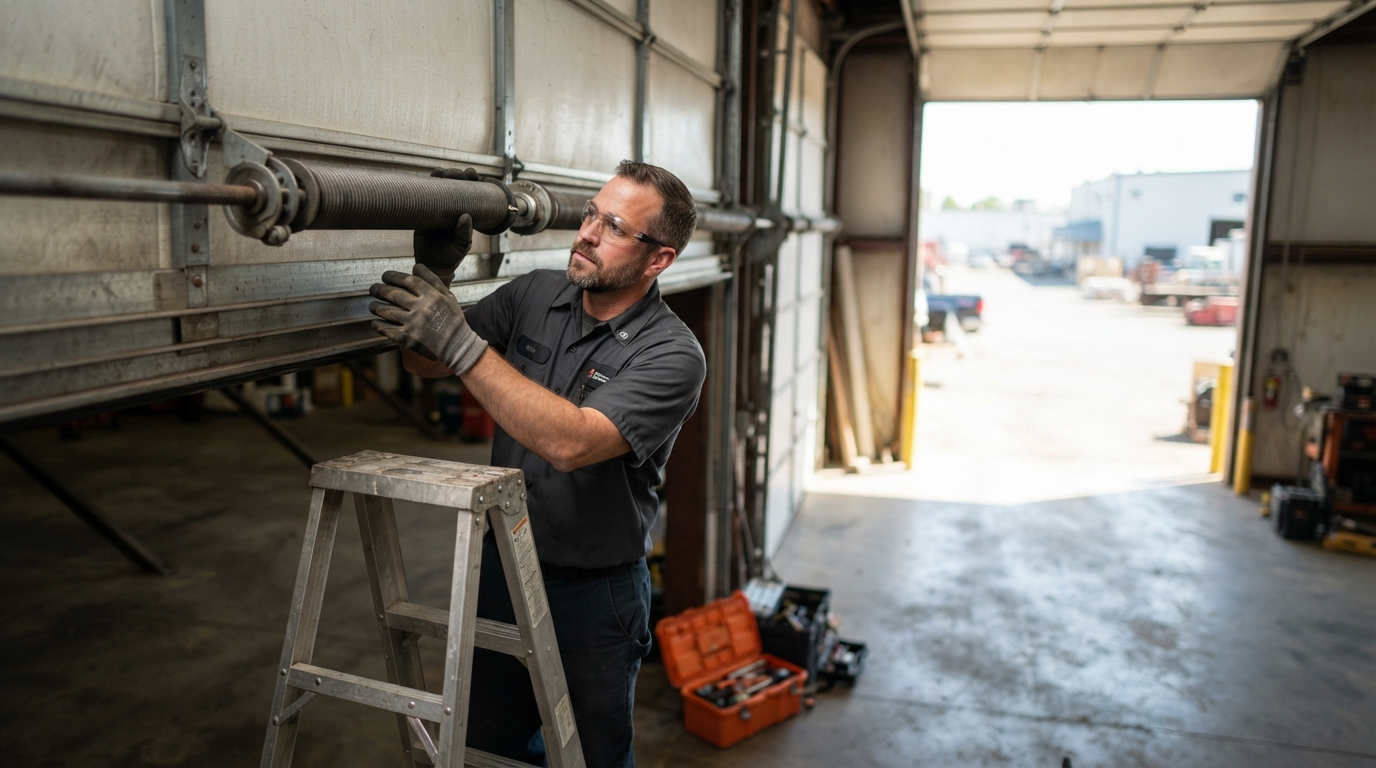
Torsion and extension springs counterbalance the weight of an overhead door, and when one fails, the door can become too heavy to lift safely or drop suddenly. The largest threat associated with a garage door comes from torsion or extension springs made of heavy-duty steel that counterbalance the weight of the door and retain a high amount of tension, sometimes maintaining a force of 100 to 300 pounds when coiled.
Because of this stored energy, spring and cable repairs are not a task for untrained individuals. The U.S. Consumer Product Safety Commission explicitly warns homeowners to keep hands and fingers away from door sections, hinges, pulleys, and springs when manually operating or repairing a door. A technician typically:
- Locks out the opener and secures the door before releasing any spring tension
- Measures the existing spring against door weight and cycle rating to select a correct replacement
- Rewinds or replaces torsion springs using calibrated winding bars rather than makeshift tools
Track Misalignment and Panel Damage
A door that binds, travels unevenly, or jumps the track often indicates bent rails, loose brackets, or a structural change caused by impact. A sectional door is designed to distribute its weight evenly across the tracks and rollers, and when a panel is dented or creased, it can lose its square shape, causing the door to sit crookedly and the misshapen panel to rub against the vertical tracks, creating friction and binding.
Panel damage itself ranges from cosmetic to structural. A damaged panel should usually be replaced instead of repaired when it is cracked, severely bent, separating, rusted through, or causing the door to bind, sag, or move unevenly. The Consumer Product Safety Commission advises that a garage door that binds, sticks, or is severely unbalanced should be serviced by a professional.
For buildings in Long Beach, CA, salt air and coastal humidity can accelerate corrosion on steel tracks and hardware, making periodic inspection especially relevant for properties near the coast.
Opener and Sensor Malfunctions
Electric openers and their safety sensors are common failure points, particularly on higher-cycle commercial doors. According to the Occupational Safety and Health Administration, overhead door systems that lack functioning safety devices can expose workers to struck-by or entrapment hazards during normal operation.
Common opener issues professionals address include:
| Symptom | Likely Cause | Typical Fix |
| Door reverses before closing | Misaligned photo-eye sensors | Realign or replace sensor units |
| Door does not respond to remote | Worn circuit board or dead battery | Replace control board or remote battery |
| Door closes partially then stops | Obstruction sensor triggering falsely | Clean sensor lenses, adjust limit settings |
| Loud grinding during travel | Worn rollers or dry chain drive | Lubricate or replace rollers and drive chain |
Technicians also verify that limit switches and force settings match the current door weight, since even a correct spring repair can be undone by incorrect opener calibration.
Frequently Asked Questions
How often should an overhead door be inspected? Commercial and industrial doors generally benefit from inspection at least once or twice a year, with more frequent checks for high-cycle doors used throughout the day.
Can a single damaged panel be replaced instead of the whole door? Sometimes, though matching an existing panel depends on the door’s age and whether the original design is still manufactured; a professional inspection determines feasibility.
Is it safe to operate a door with a bent panel? It depends on severity; a minor cosmetic dent may be low risk, but the CPSC recommends professional service for doors that bind, stick, or are severely unbalanced.
What causes most overhead door emergencies? Sudden spring or cable failure, vehicle impact to panels or tracks, and opener sensor faults account for most urgent service calls on commercial overhead doors.
Service Area and Contact Information
Based in Carson, CA, R&S Overhead Doors Of South Bay, Inc. serves customers across Long Beach, CA.
Current service area information for rsoverheaddoorofsouthbayinc.com is published for properties throughout the Long Beach, CA area.