-
A properly installed commercial roof is a core structural safety system, not just weatherproofing.
-
San Francisco’s building code, fire code, and seismic environment each impose specific requirements on commercial roofing projects.
-
Working with a licensed, experienced local contractor helps ensure code compliance from permit to final inspection.
A commercial roof does more than keep rain out. In a dense, seismically active city like San Francisco, a correctly installed roof protects occupants, satisfies regulatory requirements, and preserves the structural integrity of the entire building envelope.
For property owners and facility managers researching commercial roof installation in San Francisco CA, understanding the local code landscape is just as important as choosing the right roofing material. San Francisco layers its own municipal requirements on top of California’s statewide standards, creating a multi-step compliance process that affects every phase of a commercial project.
What San Francisco’s Code Requires for Commercial Roofing
The purpose of the San Francisco Building Code is to establish minimum requirements to safeguard public health, safety, and general welfare through structural strength, stability, and safety to life and property from fire and other hazards.
For commercial roofing specifically, that translates into several concrete obligations:
-
Permit before work begins. A permit is required before installing, repairing, or removing roofing material, and only a licensed C-39 contractor may apply for a reroofing permit.
-
Class A fire-rated materials. San Francisco follows California’s Class A fire rating requirements for roofing materials, the highest fire resistance classification available, which is especially critical in densely built neighborhoods where buildings sit in close proximity.
-
Seismic weight review. San Francisco’s seismic environment adds another layer of consideration. The additional weight of certain roofing materials, particularly concrete tile, can affect a building’s seismic performance, and the SFDBI may require a structural review for heavier roofing systems on older buildings.
-
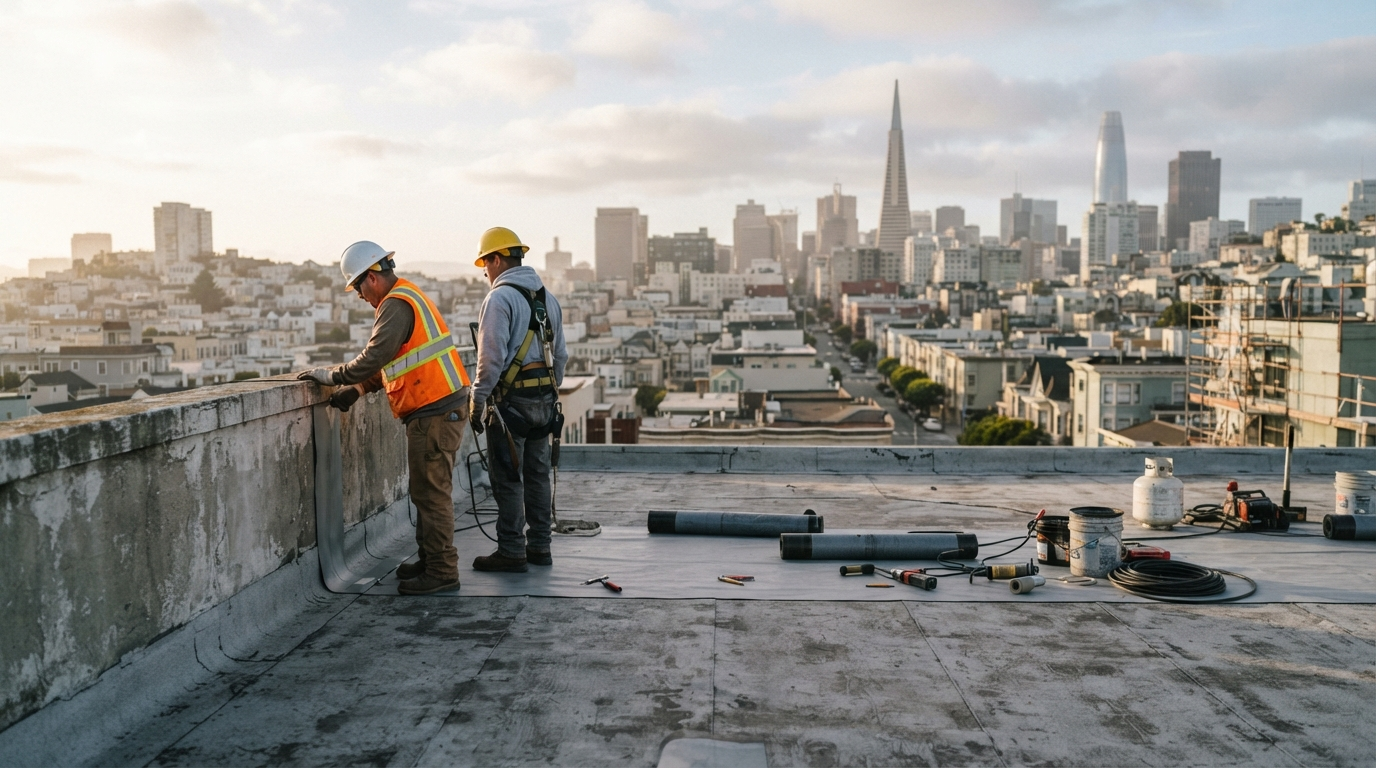
Fire department oversight for torch work. For flat roof installations using torch-applied modified bitumen, San Francisco has strict fire safety requirements through the San Francisco Fire Department, and such work may require both a DBI Building Permit and an SFFD Operational Permit for the use of open flame or LP gas during roofing operations.
According to the SF.gov reroofing permit page, only licensed C-39 contractors registered with the city can pull commercial roofing permits, which means the contractor you choose directly determines whether your project can legally proceed.
Common Commercial Roofing Systems and Their Safety Trade-offs
Unlike residential roofing, commercial roofs in California are almost always low-slope or flat systems, with TPO, EPDM, PVC, modified bitumen, and built-up roofing (BUR) being the dominant system types.
Each system carries different safety and maintenance profiles:
|
System |
Key Strength |
Primary Safety Consideration |
|---|---|---|
|
Built-Up Roofing (BUR) |
Multi-layer waterproofing, Class A fire rating |
Hot asphalt application requires fire safety protocols |
|
Modified Bitumen |
Flexible, handles temperature swings |
Torch application triggers SFFD permit requirement |
|
TPO / Single-Ply |
Reflective, energy-efficient |
Seam integrity is critical for leak prevention |
|
Sheet Metal |
Long lifespan, drainage control |
Custom fabrication required for flashing and penetrations |
Built-up roofs plied together with hot asphalt and finished with gravel can achieve a Class A fire rating, which satisfies San Francisco’s most stringent material requirement. Penetrations represent the highest-risk areas on any commercial roof, and every location where the membrane is interrupted, including HVAC curbs, pipe boots, skylights, parapet walls, and rooftop equipment supports, requires an intact flashing and sealant seal to prevent water intrusion.
Why Installation Quality Determines Long-Term Safety
Code compliance sets the floor, but installation quality determines how long a roof actually protects a building. SFDBI inspectors verify that the installation meets San Francisco’s building code requirements, including proper underlayment, flashing, ventilation, and fire-rated materials.
A few factors that separate a safe, durable installation from a marginal one:
-
Correct slope and drainage design to prevent standing water
-
Properly lapped and sealed membrane seams at all penetrations
-
Sheet metal flashing at parapets, chimneys, and wall transitions
-
Ventilation design that prevents moisture buildup in the roof assembly
A full-service commercial roofing contractor performs a variety of services that include service and maintenance programs, design-build projects, and consulting and inspection services, in addition to traditional roofing installation. That breadth matters because a roof that passes inspection on day one still needs periodic maintenance to remain structurally sound.
Choosing a Contractor for a San Francisco Commercial Project
The permit requirement alone narrows the field: only licensed C-39 contractors can legally perform and permit commercial roofing work in San Francisco. Beyond licensure, look for verifiable experience with the specific system your building requires, familiarity with SFDBI and SFFD permitting workflows, and the capacity to handle custom sheet metal work for flashing and drainage.
Contractors who specialize in roofing and sheet metal services and work on commercial and industrial buildings are better positioned to address the full scope of a commercial installation, from membrane selection through custom flashing fabrication.
Frequently Asked Questions
Do commercial buildings in San Francisco need a separate fire department permit for roofing? For flat roof installations using torch-applied modified bitumen, work may require both a DBI Building Permit for the roofing work and an SFFD Operational Permit for the use of open flame, torches, or LP gas during roofing operations. Not all systems trigger this requirement, but hot-applied systems do.
What fire rating is required for commercial roofing materials in San Francisco? All roofing materials installed under a San Francisco permit must meet required fire safety and energy efficiency standards, and the city requires roofing materials on new and replacement roofs to carry a Class A fire rating.
Can a building owner pull their own commercial roofing permit? San Francisco requires reroofing permits to be pulled by a licensed C-39 contractor registered with the city. Building owners typically cannot pull their own roofing permits.
How does seismic risk affect commercial roof selection in San Francisco? The additional weight of certain roofing materials, particularly concrete tile, can affect a building’s seismic performance, and SFDBI may require a structural review for heavier roofing systems on older buildings.
For commercial property owners in San Francisco looking for a contractor with deep local experience across flat roofing, sheet metal, and code-compliant installations, Anderson Roofing & Sheet Metal Company has served the city since 1928 and works on commercial and industrial buildings throughout the Bay Area. Reach out for a free consultation to discuss your building’s specific roofing needs.