Short version:
• Most garage door opener issues trace back to misaligned sensors, worn remote batteries, or incorrect limit and force settings.
• Federal safety rules require openers to reverse on contact with an obstruction, a feature worth testing monthly.
• Simple fixes like cleaning sensor lenses or reprogramming a remote solve many problems without a technician visit.
A garage door opener that refuses to close, reverses unexpectedly, or stops responding to remotes usually points to one of a handful of common culprits: dirty or misaligned safety sensors, depleted batteries, or settings that drifted out of calibration. Identifying which component is failing before calling for service can save time and sometimes the cost of a technician visit entirely.
Many of these issues can be diagnosed with basic observation, and in cases where parts need replacing or adjustment goes beyond a simple reset, Garage Door Opener Repair addresses the mechanical and electronic faults that homeowner troubleshooting cannot fix on its own. Understanding the difference between a quick fix and a repair that requires professional tools helps avoid unnecessary expense or, worse, continuing to operate an unsafe door.
Common Opener Problems and Likely Causes
Before assuming the motor itself has failed, it helps to rule out the simpler possibilities first.
• Door won’t respond to remote or wall switch – Often caused by dead batteries, a tripped circuit breaker, or a disconnected power cord rather than a failed motor.
• Door reverses before fully closing – Typically a sensor or limit-setting issue rather than a motor problem.
• Opener runs but door doesn’t move – Usually points to a broken drive belt, chain, or disconnected trolley arm.
• Door opens but won’t close from the remote – A frequent sign of blocked, dirty, or misaligned photo-eye sensors.
Working through this list systematically narrows down whether the fix is a five-minute adjustment or a job for a professional.
Checking and Realigning Safety Sensors
Photo-eye sensors are frequently the source of closing problems, and they are also a built-in safety feature rather than an optional convenience. Residential garage door openers sold in the United States must meet federal requirements that force the door to reverse when it senses an obstruction, a rule enforced through the Consumer Product Safety Commission’s safety standard for automatic garage door operators.
To check sensor function:
1. Look at the small indicator lights on each sensor unit near the floor. Solid lights typically mean proper alignment; a blinking light usually signals a blocked or misaligned beam.
2. Wipe each lens with a soft, dry cloth to remove dust, cobwebs, or moisture.
3. Confirm nothing is sitting in the sensor path, including bikes, trash cans, or storage boxes.
4. Gently adjust the sensor brackets until both lights show solid rather than blinking.
If the lights remain inconsistent after cleaning and realignment, the sensor or its wiring may be failing and typically needs replacement.
Testing the Auto-Reverse Function
Every opener manufactured for the current market is required to include a mechanical reversal system that stops the door when it meets resistance. Homeowners in Columbus, OH dealing with older garage systems, particularly in houses built before the 1990s, should confirm this feature works correctly given the age of housing stock in many neighborhoods.
| Test | Method | Expected Result |
| Contact reversal | Place a 2×4 flat under the closing door | Door reverses immediately on contact |
| Photo-eye test | Wave an object through the sensor beam while closing | Door stops and reverses within seconds |
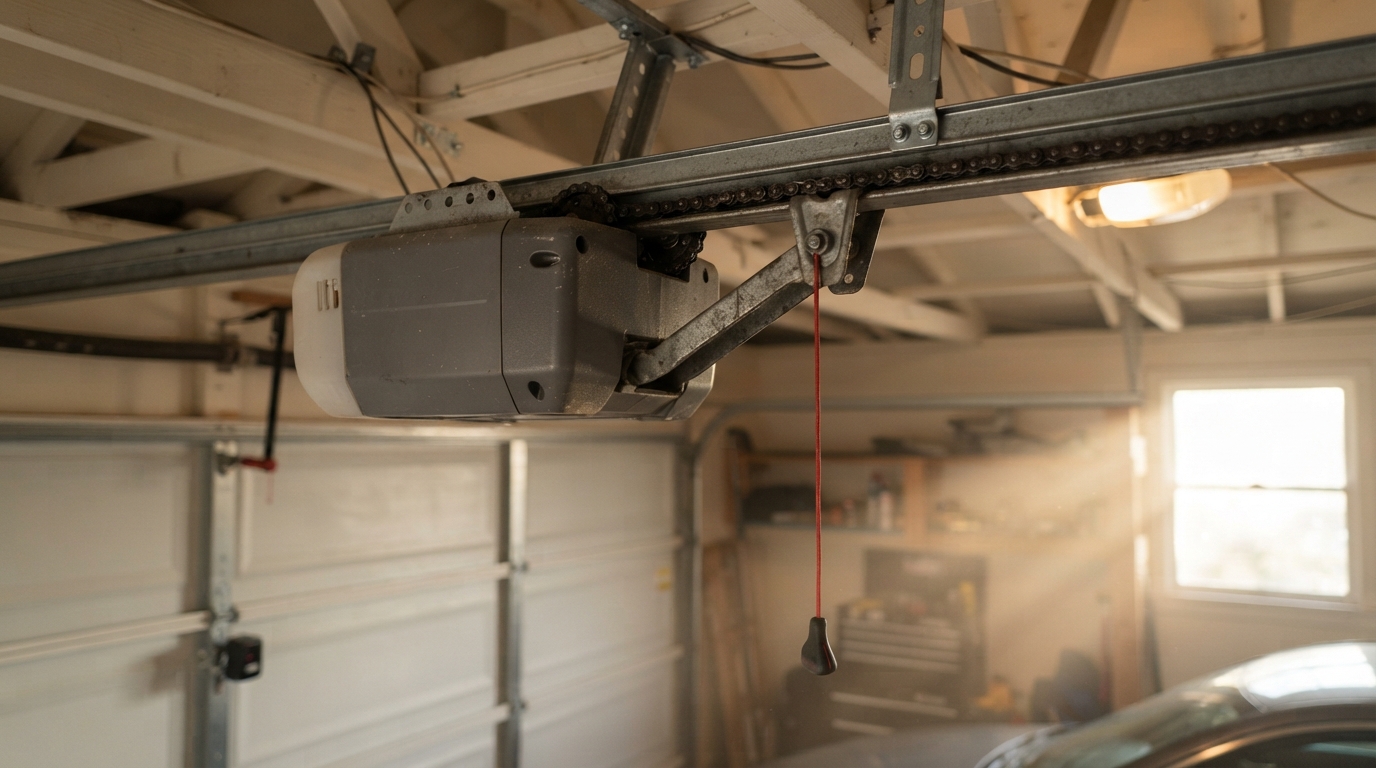
| Manual release | Pull the red release cord | Door disengages and moves freely by hand |
A door that fails either test should not be used automatically until it is adjusted or repaired, since this safety system is designed to prevent injury to people, children, and pets.
When Settings Need Adjustment
Limit and force settings control where the door stops and how much resistance the motor applies before reversing. If the door stops short of the floor or reverses immediately upon touching the ground, these settings likely need recalibration. Force set too high can mask a failing reversal system, while force set too low causes nuisance reversals even without an actual obstruction.
Frequently Asked Questions
Why does my garage door opener hum but the door doesn’t move? A humming motor with no door movement often indicates a disconnected trolley, broken drive gear, or a jammed track rather than a dead motor.
How often should safety sensors be tested? Monthly testing is recommended to confirm the sensors and reversal mechanism continue to function as intended.
Can a garage door opener be repaired, or does it need full replacement? Many issues, including sensor failures, worn gears, and circuit board faults, can be repaired without replacing the entire unit, though openers installed before 1993 may lack required safety features and warrant replacement.
What causes a remote to stop working suddenly? Weak batteries, signal interference, or a need for reprogramming are the most common causes before assuming the remote itself is broken.
Business Info
Based in Orient, OH, Compton Overhead Doors serves customers throughout Columbus, OH, with services that include garage door and opener repair alongside automatic garage door installation.
Next Steps for Opener Troubleshooting
Published service details for Compton Overhead Doors outline the local service area and hours for reference.
Diagnosing a malfunctioning garage door opener starts with the simplest checks, sensors, batteries, and settings, before assuming the motor or circuit board has failed. Working through each possibility methodically, and testing the auto-reverse safety feature regularly, keeps the system both functional and safe for everyday use.