Takeaway:
- Specifying a burner by BTU output alone is not enough — geometry, fuel type, operating pressure, and safety controls all determine whether a burner performs reliably in a commercial kitchen.
- Cleveland foodservice operators face local code requirements that must be matched to the burner spec before fabrication begins.
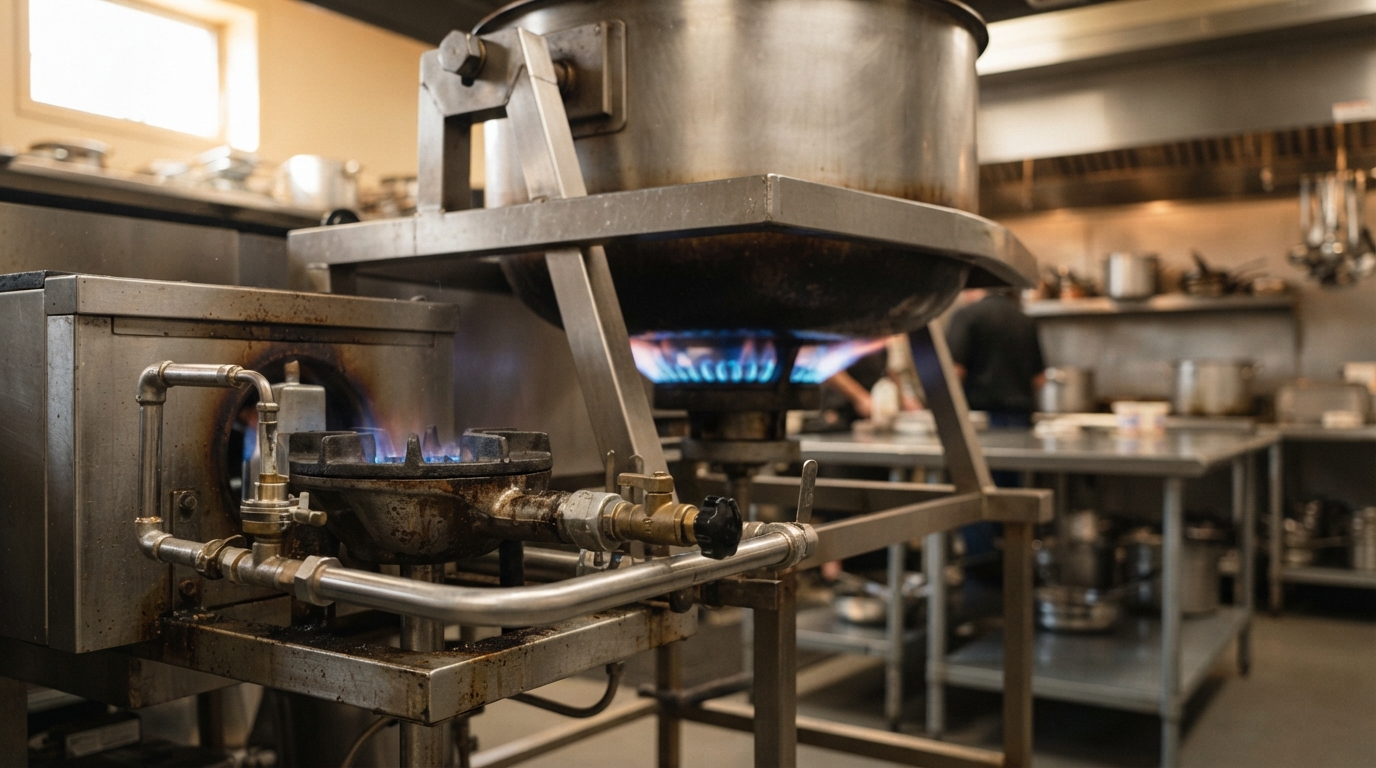
Choosing the right heating solution for a commercial kitchen starts with understanding what separates a purpose-built burner from a generic off-the-shelf unit. A custom gas burner is engineered around a specific application — its dimensions, BTU rating, port pattern, and fuel configuration are all determined by the actual cooking or processing task, not by what happens to be in stock.
BTU Output and Burner Geometry
The two most consequential decisions in any burner specification are heat output and physical form factor. These variables are closely linked: a pipe burner that is too short will create hot spots, while one that is oversized for the chamber will waste fuel and stress surrounding components.
Pipe burners are a practical choice for ovens and kettles that need long, even flame coverage along the length of a chamber. Custom lengths from roughly 10 inches to 100 inches are available, with typical outputs ranging from about 5,000 to 500,000 BTUH per burner depending on orifice, pressure, and porting.
Pipe burners provide a very uniform heat source, spreading the gas flame over the entire length of the item being heated — a meaningful advantage for large cooking tanks, kettles, and continuous-process ovens common in Cleveland’s food manufacturing and restaurant supply sectors.
Burner geometry also affects cleanability. In a commercial kitchen, grease accumulation around ports is a fire and maintenance concern. Specifying a burner profile that minimizes upward-facing horizontal surfaces reduces that risk significantly.
Fuel Type, Operating Pressure, and Venturi Design
Natural gas and propane behave differently at the orifice, and a burner sized for one fuel will not perform correctly on the other without modification. Cleveland foodservice operators connected to municipal natural gas lines typically run at low supply pressure, which makes venturi-style burners a practical fit.
Venturi mixers allow many installations to operate on low-pressure natural gas or propane, without blowers — simplifying installation and reducing mechanical failure points. For higher-output applications such as large kettle cookers or corn cookers, high-pressure venturi nozzle burners can be specified instead.
Under the National Fuel Gas Code (NFPA 54), gas connections must accommodate the total connected BTU load without creating excessive pressure drops. This means the supply line sizing, regulator setting, and burner orifice diameter must all be calculated together — not independently. Consulting the NFPA 54 National Fuel Gas Code is a standard step for any licensed engineer specifying commercial gas equipment in Ohio.
Safety Controls and Compliance Components
A burner assembly for foodservice use is more than the burner body itself. Flame safeguards, gas valves, and ignition systems are required components in any code-compliant installation.
Burner packages can integrate pilots, thermopilot flame safeguards, gas pressure gauges, slow-opening combustion valves, and digital temperature controllers. These components work together to manage ignition, monitor flame, regulate gas flow, and help maintain stable temperatures.
In a commercial foodservice environment, residential-grade or generic flexible connectors are code violations and immediate safety hazards. Engineers must specify gas hose assemblies that meet ANSI Z21.69/CSA 6.16: Connectors for Movable Gas Appliances.
The table below summarizes common burner types and their typical foodservice applications:
| Burner Type | Typical Output Range | Common Foodservice Use |
| Pipe / Ribbon Burner | 5,000 – 500,000 BTUH | Kettles, tanks, ovens, griddles |
| High-Pressure Venturi | Up to 390,000 BTUH | Large cookers, corn cookers, distillery |
| Ring Burner | Varies by diameter | Brewery kettles, hot liquor tanks |
| Rectangular Burner | Varies by size | Bread ovens, pizza ovens |
Bench Testing and Retrofit Considerations
One often-overlooked step in the procurement process is bench testing. A burner that looks correct on paper may still require tuning once the orifice, pressure, and porting interact with the actual chamber geometry.
Each custom gas burner should be bench tested and optimized to produce high heating capacity outputs for the least amount of energy consumed.
Custom burners can also be designed or modified for retrofit projects. Custom lengths, BTUH ratings, port patterns, and mixer arrangements are available, and units can be bench-tested to match the client’s existing oven, ductwork, or chamber.
For Cleveland foodservice teams replacing aging equipment or retrofitting a production kitchen, this means a custom burner can often be fabricated to drop into an existing footprint — avoiding costly structural changes.
Frequently Asked Questions
What information do I need before ordering a custom burner? At minimum, you need the fuel type (natural gas or propane), available supply pressure, required BTU output, chamber or tank dimensions, and any existing safety valve or ignition hardware that must be matched.
Can a custom burner be built to fit an existing piece of equipment? Yes. Specifications can be modified to meet exacting standards, and burners are routinely fabricated to retrofit into existing ovens, tanks, and cookers without requiring structural changes to the surrounding equipment.
Does BTU output alone determine burner size? No. Port pattern, pipe diameter, orifice size, and operating pressure all affect actual heat delivery. A burner rated at 200,000 BTUH will perform very differently depending on how those variables are configured.
What is the difference between a venturi burner and a high-pressure burner? A venturi burner draws in combustion air passively using gas flow, making it suitable for low-pressure natural gas lines. A high-pressure burner uses elevated gas pressure to achieve higher output, typically used in heavy-duty cooking or industrial applications.
For Cleveland foodservice operations that need burners built to a specific application rather than adapted from a catalog, Charles A Hones, Inc. fabricates custom gas, pipe, and high-pressure burners to client specifications, with bench testing included before delivery. Contact their team directly to discuss your application requirements and get a design started.